Early Math Skills in Preschool: How Children Learn Numbers Through Play
When parents think about maths, they often picture worksheets, sums and times tables. For children aged three to six, early maths looks very different. It happens while they sort toys by colour, count the steps up to the slide, notice that their friend has more grapes, or build a tower that keeps falling until they put the big blocks at the bottom. These everyday moments build the early math skills preschool children need before they ever write a number. This guide explains what those skills are, how they usually develop between three and six, how preschools support them through play, and what you can do at home without turning maths into a chore.
What early math skills actually are
Early maths is much broader than counting. Researchers and teachers usually describe a set of connected ideas that children build gradually, mostly through hands-on experience. Knowing them helps you spot maths in ordinary play and talk about it naturally.
- Number sense: understanding what numbers mean, not just saying them in order.
- Counting: matching one number word to one object and knowing that the last number said tells you how many there are.
- Comparing and measuring: more and fewer, bigger and smaller, longer and shorter, heavier and lighter.
- Shapes and space: recognising shapes, and understanding words such as on, under, behind, next to and between.
- Patterns and sorting: noticing what repeats, what comes next and what belongs together.
- Early problem solving: working out how to share fairly, or how many more cups are needed so everyone has one.
Number sense: the foundation for later maths
Many children can recite numbers to ten or twenty long before they understand what those numbers mean. That is completely normal. Number sense grows when children link number words to real quantities again and again: three apples, three jumps, three claps.
Seeing small amounts at a glance
One early milestone is recognising very small quantities without counting, such as seeing two or three dots on a dice and knowing straight away how many there are. Dice games, dominoes and finger games all help children build this quick recognition, which later supports adding and subtracting.
Understanding that numbers stay the same
Young children often believe that five buttons spread out in a long line are more than five buttons pushed close together. Gradually, through play, they learn that the number stays the same however the objects are arranged. You do not need to teach this directly; simply counting the same group in different arrangements and chatting about it is enough.
Counting activities for preschool children
Counting is where most families start, and it is worth doing well. The aim is not to reach high numbers quickly but to count accurately and meaningfully. These counting activities work well for preschool children at home and at school.
- Count real things during the day: stairs, spoons at the table, cars of one colour on the way home.
- Encourage touching or moving each object as it is counted, so each number word matches one object.
- After counting, ask "So how many are there?" to help your child understand that the last number tells the total.
- Play "one more" and "one fewer" games with snacks or toys, and count again to check.
- Sing counting songs and rhymes, including counting backwards, which children often enjoy.
- Let your child be the counter in board games that use a dice and a track.
If your child skips a number or counts one object twice, count together slowly rather than correcting them. Accuracy grows with practice and a relaxed atmosphere.
Shapes and patterns for kids
Shapes and patterns are an important part of early maths, and they are often where children who are less keen on counting shine. Recognising shapes helps children describe the world around them, while spotting patterns is an early form of the reasoning used later in algebra.
Shapes in everyday life
Go on a shape hunt around the house or in the street: round plates, square windows, rectangular doors, triangular roofs. Building with blocks, doing simple puzzles and cutting out shapes from paper all help children understand how shapes fit together and change when they are turned.
Making and continuing patterns
Start with simple repeating patterns using beads, blocks or stickers: red, blue, red, blue. Ask your child what comes next, then invite them to make their own pattern for you to continue. Clapping and stamping patterns, such as clap, clap, stamp, turn maths into a game the whole family can join.
- Thread beads in a colour pattern.
- Line up toy cars as big, small, big, small.
- Make a movement pattern and take turns copying it.
How early math skills develop between 3 and 6
Every child develops at their own pace, and the ranges below are only a rough guide. Children move forward in bursts and may be confident in one area while still exploring another.
- Around 3 years: many children count small groups with help, compare obvious sizes and sort objects by one feature, such as colour.
- Around 4 years: counting becomes more accurate, children start to recognise some written numbers and simple shapes, and they can often copy a simple pattern.
- Around 5 to 6 years: many children count larger groups confidently, understand "one more" and "one less", make their own patterns and use position words with ease.
If you have concerns about your child's development, talk to their teachers first. They see your child in many situations and can tell you what they notice.
How preschools support early maths
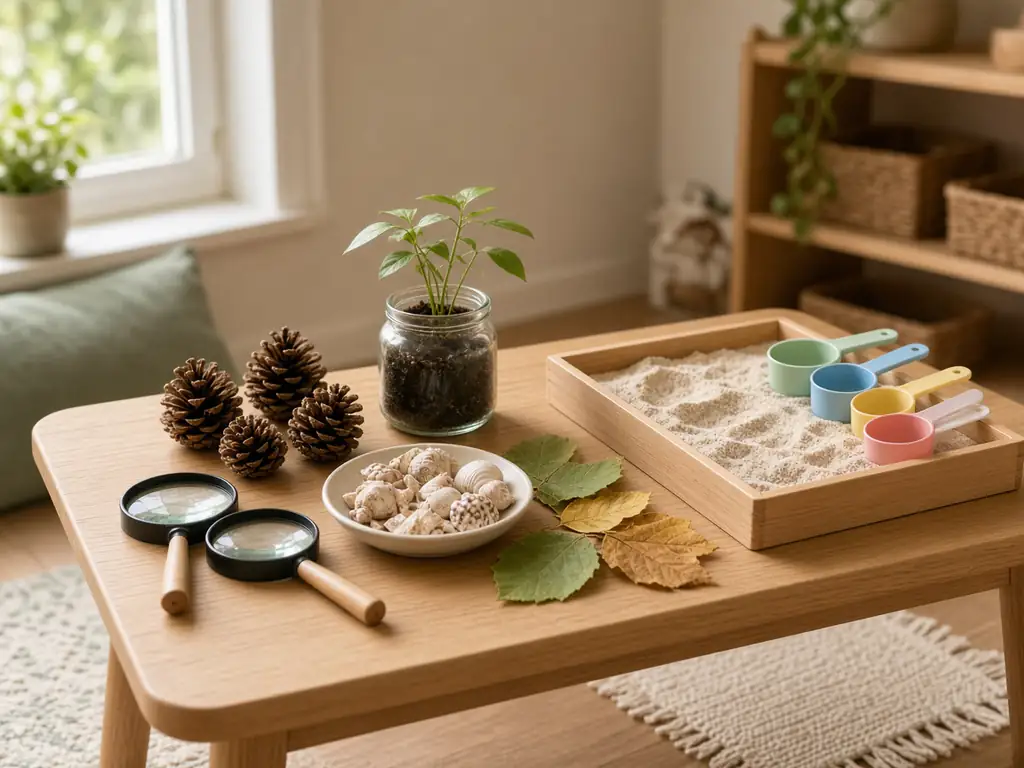
In a play-based preschool, maths is rarely a separate lesson. It is built into the day: counting children at circle time, setting the table for lunch, measuring ingredients during a cooking activity, sorting natural materials collected outdoors or building with blocks. Teachers use language on purpose, such as "Who has more?" or "What shape is the window?", so children learn to think and talk mathematically.
At Altın Anahtar's preschool in Alsancak, the programme for children aged 3 to 6 is based on play, discovery and hands-on activities that support cognitive development and school readiness. Teaching is in Turkish, with English built into the daily programme, so children also meet numbers and shape words in English through songs and games. For more guides on this age group, visit the Kyrenia Preschool Guide.
Supporting number sense at home without pressure
You do not need special materials or a maths background to help. What matters most is that maths feels playful and part of everyday life. Children who enjoy numbers early are more likely to approach maths with confidence later.
- Talk about numbers naturally: "We need four plates tonight. Can you count them out?"
- Cook together and let your child count spoonfuls or compare full and empty cups.
- Play shop with toys and pretend coins, taking turns to be the shopkeeper.
- Read picture books with numbers, shapes and patterns, and pause to count or spot shapes.
- Use waiting time for guessing games: "How many red cars do you think we will see?"
- Praise effort and thinking, such as "You checked by counting again, well done", rather than speed.
Common questions parents have about early maths
Parents often worry that their child is behind because a friend can count higher or write numbers already. In the early years, broad understanding matters much more than how far a child can count. A child who can share six grapes fairly between two friends is showing real mathematical thinking, even if they cannot yet write the number six.
Screens and apps can be fun, but they do not replace hands-on play. Young children learn number ideas best by touching, moving and talking about real objects with an adult. If you are choosing a preschool and want to see how learning through play works in practice, you can get in touch with the Altın Anahtar team to arrange a visit by appointment.
Frequently Asked Questions
At what age should my child be able to count to ten?
Children vary widely. Many can say the numbers to ten by around four, but understanding what the numbers mean and counting objects accurately often comes later. Focus on meaningful counting rather than reciting.
Should my preschooler learn to write numbers?
Writing numbers can wait. Understanding quantities, comparing and counting objects matter more at this age. Many children become interested in writing numbers on their own as their fine motor skills develop.
What are good counting activities for preschool at home?
Count real objects during daily routines, play dice and board games, sing counting songs and play simple shop games. Short, playful moments work better than long sessions.
How are shapes and patterns linked to maths?
Recognising shapes builds spatial understanding, and spotting and continuing patterns is an early form of mathematical reasoning. Both are part of the early maths children develop in preschool.
Is maths taught in English at Altın Anahtar?
Teaching at Altın Anahtar is in Turkish. English is part of the daily programme, so children also hear number and shape words in English through songs and games.